

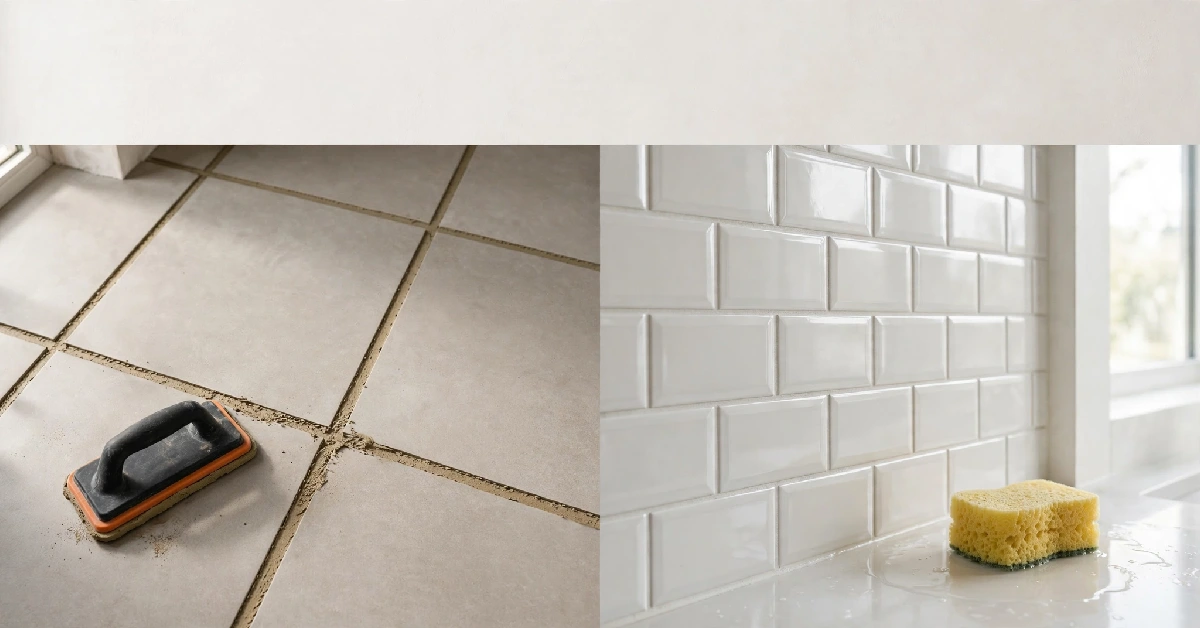
Choosing the wrong grout type can crack your joints, stain your tile, or leave your installation looking uneven within a year. Sanded grout contains fine sand particles that add body and strength to wider joints. Unsanded grout has a smooth, thinner consistency designed for narrow gaps. The joint width is the single most important factor in deciding which one to use. Get this right, and your tile work holds up for decades.
Most tile professionals use 1/8 inch as the dividing line. Joints 1/8 inch or wider generally call for sanded grout. Joints narrower than 1/8 inch call for unsanded. That rule holds true in the majority of situations. The type of tile, the surface you’re tiling, and the finish you want can all shift that decision slightly. This article walks you through every scenario so you can choose with confidence.
What Sets Sanded and Unsanded Grout Apart
The core difference is physical composition. Sanded grout contains fine quartz or silica sand mixed into the cement base. That sand acts as an aggregate, filler, and binding agent. It adds tensile strength and helps prevent the grout from shrinking as it cures, which matters a lot when you’re filling joints wider than 1/8 inch. The cement gives the mix adhesive properties. Without sand, wider joints would dry, crack, and crumble.
Unsanded grout skips the sand entirely. It uses a finer cement formula with added polymers to hold its shape in narrow gaps. The smooth texture lets it press into tight joints without air pockets. It also clings to vertical surfaces better during application, which is why it’s popular for wall tiles and glass mosaics.
Both types come in cement-based and epoxy versions. Epoxy grout uses a base and an activator. When mixed, they cure through a non-reversible chemical reaction that creates a strong, stain-resistant bond. It costs more, can be harder to work with because of its short working time, but it’s worth considering for kitchens, bathrooms, and commercial floors.
When Sanded Grout Is the Right Call
Use sanded grout any time your joints are 1/8 inch wide or larger. Floor tiles typically have wider joints, and sanded grout handles the foot traffic stress that comes with them. The sand adds compressive strength, so the grout doesn’t crack under weight or movement.
Sanded grout also works well for rustic or handmade tiles. These tiles often have irregular edges and inconsistent sizing. Wider joints compensate for those variations, and sanded grout fills them cleanly without sagging.
For joints 3/8 inch or larger, use a wide-joint mixture grout. It has a higher volume of large aggregate to further reduce shrinkage.
Common situations where sanded grout is the correct choice:
- Floor tiles with joints 1/8 inch to 1/2 inch wide
- Large-format tiles (12×12 and above) with standard spacing
- Outdoor tiles, patios, and driveways exposed to temperature changes
- Subway tiles installed with a wider grout gap for a classic look
- Natural stone tiles like slate, travertine, or tumbled marble
- Matte porcelain, terracotta, and other scratch-resistant floor tiles
- Hallway and kitchen floors that see heavy foot traffic
One caution: sanded grout can scratch polished or soft stone surfaces like marble and limestone. The sand particles drag across the tile face during application. If you’re working with polished stone and wide joints are unavoidable, use an epoxy-based unsanded grout or test a small area first.
When Unsanded Grout Does the Job Better
Unsanded grout is designed for joints narrower than 1/8 inch. It flows into tight spaces without leaving voids. The absence of sand means it won’t cause drag marks on delicate tile surfaces like glass, mirrored tile, glazed ceramic, polished porcelain, or Calacatta marble.
It’s also the better option for vertical tile work. Sanded grout can slump on walls because the weight of the sand pulls it down before it cures. Unsanded grout stays in place, giving you cleaner lines and less cleanup.
Use unsanded grout for these installations:
- Mosaic tiles, including glass and ceramic mosaics
- Polished marble, travertine, or other scratch-sensitive stone
- Wall tiles with tight factory-cut joints
- Ceramic or porcelain wall tiles in showers and backsplashes
- Powder room walls, fireplace surrounds, and accent walls
- Any tile with a joint smaller than 1/8 inch
Unsanded grout does have a limitation. It tends to shrink slightly more than sanded grout as it cures. In wider joints, that shrinkage creates gaps and cracking. Keep unsanded grout in narrow joints where it performs best.
Sanded vs Unsanded Grout for Popular Tile Projects
Backsplash Tiles
Most kitchen backsplash tiles are ceramic or glass, and installers typically space them with 1/16 inch joints. Unsanded grout is the standard choice here. It fills those narrow gaps and doesn’t scratch glazed or glass tile faces.
If you’re installing a natural stone backsplash with wider spacing, switch to sanded grout. The rule still applies regardless of the room.
Shower Floors and Walls
Shower floors often use small mosaic tiles, which means many joints but very narrow ones. Unsanded grout works well here. For shower walls with standard ceramic tile and tight joints, unsanded grout also applies.
For a pebble stone shower floor with irregular sizing and wider gaps, use sanded grout. The sand gives it the body to fill uneven joints without shrinking.
Large-Format Floor Tiles
Tiles 24×24 inches or larger are often installed with a 3/16 inch joint. Sanded grout handles this width without shrinking or cracking. Some installers prefer a polymer-modified sanded grout for large-format installations, since the polymer adds flexibility to handle minor subfloor movement.
Walls, Backsplashes, and Floors: What to Use?
For accent walls, fireplace surrounds, and powder room walls with narrow joints under 1/8 inch, unsanded grout is usually the safer choice. It won’t scratch glossy or polished surfaces and stays in place on vertical surfaces.
For kitchen and hallway floors, sanded grout is the better option because it resists cracking under foot traffic. Use it for joints 1/8 inch or wider and for scratch-resistant tiles like matte porcelain or terracotta.
Colour, Cost, and Durability Compared
Both grout types come in a wide range of colors, typically 40 to 100 options depending on the brand. Sanded grout often offers more color choices because it is the more common floor grout. Unsanded grout may have fewer options, though availability varies by brand. Sanded grout can look slightly more textured after it cures, while unsanded grout dries to a smoother finish. For high-polish tile with tight joints, that smooth finish looks cleaner.
On cost, sanded grout is generally less expensive because sand is an inexpensive filler. Unsanded grout can cost more—sometimes nearly twice as much—because it relies on pricier polymers and mineral particles to compensate for the lack of sand. A 10-pound bag of sanded grout typically runs $12 to $20. Epoxy versions of both cost significantly more, often $40 to $80 for the same coverage area, but they resist staining and chemicals far better than cement-based grout.
Sanded grout has a coarse texture that can trap dirt and grime, so it may need more scrubbing. Unsanded grout is smoother and easier to clean. Durability over time depends more on application quality than on which type you choose. Grout sealed properly and maintained with pH-neutral cleaners lasts 10 to 20 years in most residential installations.
Mistakes That Cause Grout Failures
The most common mistake is using unsanded grout in wide joints. The grout shrinks as it dries, cracks appear within months, and water gets behind the tile. Using sanded grout in narrow joints is the opposite problem. The sand particles can’t compact tightly enough, leaving voids where moisture collects, and mold grows.
Mixing grout too thin is another frequent error. Both types need a thick, peanut butter-like consistency before you press them into joints. Too much water weakens the bond and causes color fading. Adding extra water to sanded grout to force it into narrow joints can also cause pinholing. Pinholes are small holes that form when trapped water evaporates and the grout above collapses. They look like shoddy workmanship and can compromise durability.
Grouting too soon after setting the tile causes problems as well. Most tile adhesives or mortars need at least 24 hours to cure before you introduce grout. Rushing this step can loosen tiles and compromise the entire installation.
Skipping sealant is a long-term mistake. Cement-based grout, both sanded and unsanded, is porous and acts as a moisture barrier only when properly sealed. Without a penetrating sealer applied after the grout cures, stains from grease, coffee, or soap scum become permanent.
Practical Tips for a Clean, Lasting Grout Job
- Use the right tools: a rubber grout float for pressing grout into joints and a damp sponge for cleanup.
- Test color before full application. Grout color can vary slightly once it dries, so mix a small batch and test it with a sample tile.
- Follow manufacturer instructions for mixing ratios, curing times, and tile compatibility.
- Avoid over-watering the mix. It weakens the grout and can cause pinholing.
- Work in small sections and wipe excess grout promptly with a damp sponge to prevent haze and streaks.
- Allow grout to cure 24 to 72 hours before walking on or wetting the surface.
- Seal cement-based grout 48 to 72 hours after it has fully cured.
- Check grout regularly for cracks, chips, or loose sections, and repair them early.
FAQs
Can you use sanded grout on wall tiles?
You can, but it’s not ideal. Sanded grout is heavier and tends to slump on vertical surfaces during application. For wall tiles with joints under 1/8 inch, unsanded grout is easier to work with and gives a cleaner result.
Is unsanded grout weaker than sanded grout?
For narrow joints, no. Unsanded grout performs just as well as sanded grout when used in joints under 1/8 inch. In wider joints, it does crack, but that’s a misapplication issue rather than a product weakness.
What is the maximum gap for unsanded grout?
Unsanded grout is designed for joints narrower than 1/8 inch. It can sometimes work up to 1/8 inch, but wider joints should use sanded grout because unsanded grout shrinks and cracks.
Sanded or unsanded grout for a kitchen backsplash?
Most kitchen backsplashes have ceramic or glass tiles with 1/16 inch joints, so unsanded grout is the standard choice. If the backsplash uses natural stone or large-format tiles with wider joints, use sanded grout instead.
Is unsanded grout suitable for shower walls?
Yes, for standard ceramic or porcelain wall tiles with tight joints. Unsanded grout stays in place on vertical surfaces and won’t scratch glazed or polished tile.
Do you need to seal sanded grout in the shower?
Yes. Cement-based sanded grout is porous. Seal it 48 to 72 hours after it has fully cured to help prevent water penetration, staining, and mold growth.
Do you need to seal both types?
Yes. Both cement-based sanded and unsanded grouts are porous and will absorb stains without a sealer. Apply a penetrating grout sealer 48 to 72 hours after the grout has fully cured.
How long should you let unsanded grout sit before wiping?
Follow the manufacturer’s instructions. In most cases, you should let it firm up slightly, then wipe excess promptly with a damp sponge. Working in small sections prevents haze and streaks.
Can I apply new grout over old grout?
In some cases, you can apply new grout over old grout if the old grout is clean, sound, and not crumbling. Remove loose or cracked sections first, and make sure the new grout is compatible with the existing grout and tile.
What grout works best for glass tile?
Unsanded grout is the standard choice for glass tile. Sand particles can scratch the glass surface during application. Use a white or light gray unsanded grout for translucent glass tiles to avoid color showing through the tile.
Can you mix sanded and unsanded grout?
Some installers mix them to get an in-between texture for 1/8 inch joints. The practice is not widely recommended because the ratio is difficult to control and the results are inconsistent. At 1/8 inch, either type can work, so pick one and stay consistent.