

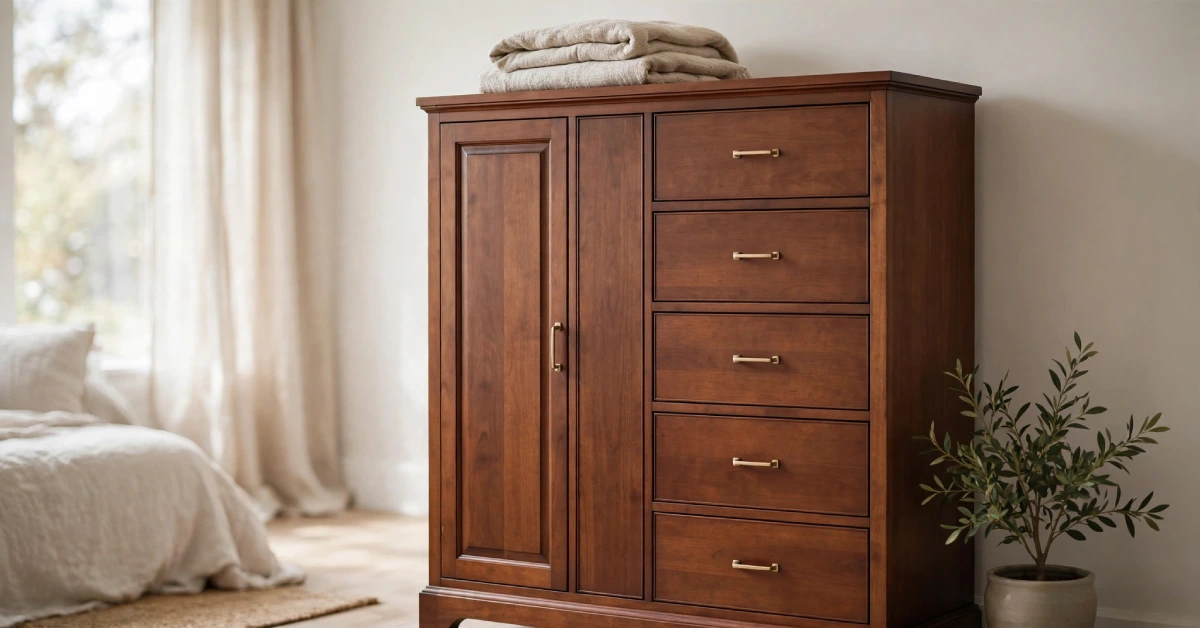
A chifferobe is a single piece of bedroom furniture that combines a wardrobe and a chest of drawers. One side holds a hanging rod behind a door, and the other holds a stack of drawers.
First sold in the early 1900s, the chifferobe solved a real problem: bedrooms with no closet.
What Is a Chifferobe?
A chifferobe is a tall cabinet that does two jobs at once. Open one door, and you find a hanging rod for shirts, dresses, and coats. Open the other section,n and you find drawers for folded clothes, socks, and linens.
That split design is what sets it apart from a plain dresser or a simple wardrobe. You get both storage styles in one footprint, which matters when your bedroom cannot fit a dresser and a wardrobe side by side.
You may also see the word spelt chifforobe or chiffarobe. All three spellings point to the same piece of furniture, and dictionaries list them as variants of one another, according to Dictionary.com.
Where the Word Chifforobe Came From
The name is a blend of two older furniture words. Chiffonier described a tall, narrow chest of drawers, often with a mirror on top. Wardrobe described a closed cabinet built for hanging clothes. Put them together, and you get chifferobe, a piece built to do what both did at once.
Word historians trace the term to 1903, when it was used to name furniture that combined drawers with hanging space, according to the Online Etymology Dictionary. Merriam-Webster dates the first printed use to 1908, in a mail-order catalogue.
That catalogue was Sears, Roebuck. Furniture historians at DutchCrafters note that the Sears catalogue introduced the piece at the start of the 20th century as a single cabinet built for homes without closets. The idea caught on fast, especially across the American South, where older houses rarely had built-in closet space.
The word still carries that regional flavour today. Chifferobe shows up often in Southern fiction, including Harper Lee’s To Kill a Mockingbird, where a character asks a young witness to lift a box down from one.
Chifferobe vs Armoire vs Wardrobe
Shoppers mix these three words up constantly, and furniture listings do not always help. Here is the plain difference:
- Wardrobe: a tall cabinet with a hanging rod and, usually, little or no drawer space.
- Armoire: the broader French term for a freestanding cabinet with doors. Inside, it might hold a rod, shelves, drawers, or a mix of all three.
- Chifferobe: a specific type of combination cabinet. One section always hangs clothes, and the other always holds drawers, in a fixed split.
In practical terms, a chifferobe is a kind of armoire, but not every armoire is a chifferobe. Furniture retailer Contempo Space puts it simply: a chifferobe always pairs drawers with hanging space, while an armoire’s interior can be configured almost any way a buyer wants.
If you are furnishing a whole room rather than filling one storage gap, it helps to see the piece next to a full set. A full-size bedroom set shows how a chifferobe or wardrobe piece can sit alongside a bed frame and nightstands without crowding the room.
Why the Chifferobe Is Back in Style
Closets have gotten more common since 1908, but small living has made the chifferobe useful again. The average new U.S. apartment measured 910 square feet in 2025, and the smallest units in the country run well under 500 square feet, according to RentCafe and HireAHelper data. Studios and one-bedroom units now make up more than half of new apartment stock nationwide.
Closet space has not kept pace with that squeeze. Storage industry research from StorageCafe found that clothing is the second most common reason people rent a self-storage unit, and that renters in studio and one-bedroom homes are three times more likely to need that overflow space than people in four-bedroom houses.
Interior designers have noticed the shift back toward standalone storage furniture. “I’m predicting that 2025 is going to be the year of the armoire,” designer Kathy Kuo told Homes & Gardens, pointing to pieces that combine shelving with a hanging rod as especially practical.
A chifferobe answers that need directly. It gives a closetless bedroom, a guest room, or a converted den both hanging space and drawer space, without the cost or disruption of a built-in closet renovation.
How to Size a Chifferobe for Your Room
Measure before you shop. Chifferobes vary widely in width, and a piece that looks compact in a photo can overwhelm a small wall in person:
- Compact chifferobes: roughly 36 to 42 inches wide, a good fit for a guest room, nursery, or small apartment bedroom, according to sizing guidance from Weaver Furniture.
- Standard chifferobes: 44 to 55 inches wide, with room for four to six drawers plus a full hanging section.
- Larger chifferobes: built-to-order pieces from Amish workshops that can run 60 inches or more, often with a mirrored door and extra shelving.
Leave at least 24 inches of clearance in front of the piece so drawers and doors open fully. If you are planning a full room layout rather than a single furniture swap, a set of 10×12 bedroom design ideas can help you work out where a chifferobe fits next to the bed and dresser before you commit to a size.
Height matters as much as width. Standard chifferobes run 60 to 72 inches tall, tall enough for full-length dresses and coats to hang without folding.
Where a Chifferobe Works Best
What Is a Chifferobe? History, Uses, and How to Choose One
A chifferobe is a single piece of bedroom furniture that combines a wardrobe and a chest of drawers. One side holds a hanging rod behind a door, and the other holds a stack of drawers. First sold in the early 1900s, the chifferobe solved a real problem: bedrooms with no closet.
What Is a Chifferobe?
A chifferobe is a tall cabinet that does two jobs at once. Open one door, and you find a hanging rod for shirts, dresses, and coats. Open the other section,n and you find drawers for folded clothes, socks, and linens.
That split design is what sets it apart from a plain dresser or a simple wardrobe. You get both storage styles in one footprint, which matters when your bedroom cannot fit a dresser and a wardrobe side by side.
You may also see the word spelt chifforobe or chiffarobe. All three spellings point to the same piece of furniture, and dictionaries list them as variants of one another, according to Dictionary.com.
Where the Word Chifferobe Came From
The name is a blend of two older furniture words. Chiffonier described a tall, narrow chest of drawers, often with a mirror on top. Wardrobe described a closed cabinet built for hanging clothes. Put them together, and you get chifferobe, a piece built to do what both did at once.
Word historians trace the term to 1903, when it was used to name furniture that combined drawers with hanging space, according to the Online Etymology Dictionary. Merriam-Webster dates the first printed use to 1908, in a mail-order catalogue.
That catalogue was Sears, Roebuck. Furniture historians at DutchCrafters note that the Sears catalogue introduced the piece at the start of the 20th century as a single cabinet built for homes without closets. The idea caught on fast, especially across the American South, where older houses rarely had built-in closet space.
The word still carries that regional flavour today. Chifferobe shows up often in Southern fiction, including Harper Lee’s To Kill a Mockingbird, where a character asks a young witness to lift a box down from one.
Chifferobe vs Armoire vs Wardrobe
Shoppers mix these three words up constantly, and furniture listings do not always help. Here is the plain difference:
- Wardrobe: a tall cabinet with a hanging rod and, usually, little or no drawer space.
- Armoire: the broader French term for a freestanding cabinet with doors. Inside, it might hold a rod, shelves, drawers, or a mix of all three.
- Chifferobe: a specific type of combination cabinet. One section always hangs clothes, and the other always holds drawers, in a fixed split.
In practical terms, a chifferobe is a kind of armoire, but not every armoire is a chifferobe. Furniture retailer Contempo Space puts it simply: a chifferobe always pairs drawers with hanging space, while an armoire’s interior can be configured almost any way a buyer wants.
If you are furnishing a whole room rather than filling one storage gap, it helps to see the piece next to a full set. A full-size bedroom set shows how a chifferobe or wardrobe piece can sit alongside a bed frame and nightstands without crowding the room.
Why the Chifferobe Is Back in Style
Closets have gotten more common since 1908, but small living has made the chifferobe useful again. The average new U.S. apartment measured 910 square feet in 2025, and the smallest units in the country run well under 500 square feet, according to RentCafe and HireAHelper data. Studios and one-bedroom units now make up more than half of new apartment stock nationwide.
Closet space has not kept pace with that squeeze. Storage industry research from StorageCafe found that clothing is the second most common reason people rent a self-storage unit, and that renters in studio and one-bedroom homes are three times more likely to need that overflow space than people in four-bedroom houses.
Interior designers have noticed the shift back toward standalone storage furniture. “I’m predicting that 2025 is going to be the year of the armoire,” designer Kathy Kuo told Homes & Gardens, pointing to pieces that combine shelving with a hanging rod as especially practical.
A chifferobe answers that need directly. It gives a closetless bedroom, a guest room, or a converted den both hanging space and drawer space, without the cost or disruption of a built-in closet renovation.
How to Size a Chifferobe for Your Room
Measure before you shop. Chifferobes vary widely in width, and a piece that looks compact in a photo can overwhelm a small wall in person.
- Compact chifferobes: roughly 36 to 42 inches wide, a good fit for a guest room, nursery, or small apartment bedroom, according to sizing guidance from Weaver Furniture.
- Standard chifferobes: 44 to 55 inches wide, with room for four to six drawers plus a full hanging section.
- Larger chifferobes: built-to-order pieces from Amish workshops that can run 60 inches or more, often with a mirrored door and extra shelving.
Leave at least 24 inches of clearance in front of the piece so drawers and doors open fully. If you are planning a full room layout rather than a single furniture swap, a set of 10×12 bedroom design ideas can help you work out where a chifferobe fits next to the bed and dresser before you commit to a size.
Height matters as much as width. Standard chifferobes run 60 to 72 inches tall, tall enough for full-length dresses and coats to hang without folding.
Where a Chifferobe Works Best
The chifferobe was built for bedrooms without closets, and that is still its strongest use case. It works especially well in these settings.
- Older homes or apartments with small or missing bedroom closets
- Guest rooms that need flexible storage without a permanent closet build-out
- Nurseries and kids’ rooms, where drawers hold folded onesies and the hanging side holds dress clothes
- Home offices or craft rooms, where the drawer stack holds supplies and the hanging side holds a garment rack or extra shelving
- Entryways, where the piece doubles as coat and accessory storage
A chifferobe can also stand in as a compact entertainment cabinet in a small living room, with the hanging section adapted for shelving. Painted finishes work well here. A soft, warm white like Swiss Coffee paint pairs naturally with a wood or painted chifferobe, since it keeps the piece from reading as heavy furniture in a smaller room.
New, Amish, or Antique: How to Buy
You have three main paths to owning a chifferobe, and each comes with a different price and timeline.
New manufactured pieces are the fastest and most affordable option. Retailers such as Contempo Space sell factory-built armoire and chifferobe combinations from around $689 to $1,199, with sizes starting near 16.5 inches wide for tight spaces.
Amish-made, solid wood chifferobes cost more but are built to last generations. Countryside Amish Furniture lists solid wood chifferobes ranging from roughly $2,795 to over $5,000, with features like dovetailed drawers, soft-close slides, and adjustable interior shelving. These pieces are usually made to order, so plan on a lead time of several months rather than next-day delivery.
Vintage and antique chifferobes offer character new furniture cannot match. Pieces from the 1920s through the 1950s show up regularly through estate sales, vintage dealers, and online marketplaces, often in walnut or mahogany with original hardware. Before buying secondhand, check the drawer glides, test that doors close flush, and look closely at any veneer for lifting or water damage, since repairs on older wood joinery can add real cost after the sale.
Whichever route you choose, measure your wall, your doorway, and your stairwell first. A chifferobe that will not fit through a hallway turn is a common and avoidable mistake.
How to Care for a Wood Chifferobe
A solid wood chifferobe can last decades if you treat the wood and the hardware right. A few habits protect the investment, whether the piece is new or a century old.
Keep it away from direct sunlight and heating vents. Wood expands and contracts with temperature and humidity, and a spot near a radiator or a south-facing window will dry out the joints faster than normal use ever would. Aim for a room that stays fairly steady, somewhere between 35 and 55 per cent humidity.
Dust with a soft, dry cloth rather than reaching for spray polish every week. Most polishes leave a buildup over time that dulls the finish and attracts more dust. A light coat of furniture wax once or twice a year does more good than weekly spraying.
Check drawer glides and hinges twice a year. A drawer that sticks usually needs nothing more than a bit of paraffin wax or a dry silicone spray on the runners. Loose hinge screws are common on older pieces and take five minutes to tighten.
If you inherit or buy a vintage chifferobe, resist the urge to strip and refinish it right away. Original finish, even when worn, often holds more resale and sentimental value than a fresh coat of polyurethane. A light cleaning and a coat of quality wax usually bring back more shine than people expect.
Common Mistakes When Buying a Chifferobe
A few buying mistakes show up again and again, and most are easy to avoid with a little planning.
- Skipping the doorway test: measure the width of every doorway, stairwell turn, and hallway corner between the truck and the bedroom, including the ones before the final room.
- Guessing at drawer capacity: count your folded clothing categories first (shirts, socks, workout gear, linens) and match that to the number and depth of drawers, rather than judging by the overall cabinet size alone.
- Ignoring the door swing: a hinged door needs open floor space in front of it, which can eat into a small bedroom more than buyers expect.
- Buying vintage without checking structure: cosmetic wear is normal on an antique piece, but a racked frame, split panels, or a sagging backboard points to costly repair.
- Forgetting the finish match: a chifferobe does not need to match your bed and dresser exactly, but wildly different wood tones or hardware finishes can make a bedroom feel unplanned.
Working through this list before you order, whether from a retailer, an Amish workshop, or a vintage dealer, saves a return shipment or an afternoon spent removing a door frame.
Chifferobe FAQs
What is the difference between a chifferobe and a dresser?
A dresser is only drawers. A chifferobe adds a hanging section behind its own door, so you get closet-style storage in the same piece.
Is chifferobe the same word as chifforobe?
Yes. Chifferobe, chifforobe, and chiffarobe are spelling variants of the same word and the same piece of furniture. Chifforobe is the more common spelling in furniture retail, while chifferobe appears often in antique listings and Southern usage.
Can a chifferobe replace a closet?
For one person’s wardrobe, often yes. A standard chifferobe holds several drawers of folded clothing plus a full hanging rod, which covers most of what a small reach-in closet would hold. It will not replace a walk-in closet built for two people’s wardrobes.
How much does a chifferobe cost?
New manufactured pieces start around $700. Solid wood, Amish-made chifferobes typically run from $2,800 to $5,000 or more. Vintage pieces vary widely based on wood, condition, and region, often landing somewhere in between.
Do people still use the word chifferobe?
Yes, though less often than a century ago. The word remains common in the American South, in antique and vintage furniture listings, and in literature set in that region, including To Kill a Mockingbird.z
- Older homes or apartments with small or missing bedroom closets
- Guest rooms that need flexible storage without a permanent closet build-out
- Nurseries and kids’ rooms, where drawers hold folded onesies and the hanging side holds dress clothes
- Home offices or craft rooms, where the drawer stack holds supplies and the hanging side holds a garment rack or extra shelving
- Entryways, where the piece doubles as coat and accessory storage
A chifferobe can also stand in as a compact entertainment cabinet in a small living room, with the hanging section adapted for shelving. Painted finishes work well here. A soft, warm white like Swiss Coffee paint pairs naturally with a wood or painted chifferobe, since it keeps the piece from reading as heavy furniture in a smaller room.
New, Amish, or Antique: How to Buy
You have three main paths to owning a chifferobe, and each comes with a different price and timeline.
New manufactured pieces are the fastest and most affordable option. Retailers such as Contempo Space sell factory-built armoire and chifferobe combinations from around $689 to $1,199, with sizes starting near 16.5 inches wide for tight spaces.
Amish-made, solid wood chifferobes cost more but are built to last generations. Countryside Amish Furniture lists solid wood chifferobes ranging from roughly $2,795 to over $5,000, with features like dovetailed drawers, soft-close slides, and adjustable interior shelving. These pieces are usually made to order, so plan on a lead time of several months rather than next-day delivery.
Vintage and antique chifferobes offer character new furniture cannot match. Pieces from the 1920s through the 1950s show up regularly through estate sales, vintage dealers, and online marketplaces, often in walnut or mahogany with original hardware. Before buying secondhand, check the drawer glides, test that doors close flush, and look closely at any veneer for lifting or water damage, since repairs on older wood joinery can add real cost after the sale.
Whichever route you choose, measure your wall, your doorway, and your stairwell first. A chifferobe that will not fit through a hallway turn is a common and avoidable mistake.
How to Care for a Wood Chifferobe
A solid wood chifferobe can last decades if you treat the wood and the hardware right. A few habits protect the investment, whether the piece is new or a century old.
Keep it away from direct sunlight and heating vents. Wood expands and contracts with temperature and humidity, and a spot near a radiator or a south-facing window will dry out the joints faster than normal use ever would. Aim for a room that stays fairly steady, somewhere between 35 and 55 per cent humidity.
Dust with a soft, dry cloth rather than reaching for spray polish every week. Most polishes leave a buildup over time that dulls the finish and attracts more dust. A light coat of furniture wax once or twice a year does more good than weekly spraying.
Check drawer glides and hinges twice a year. A drawer that sticks usually needs nothing more than a bit of paraffin wax or a dry silicone spray on the runners. Loose hinge screws are common on older pieces and take five minutes to tighten.
If you inherit or buy a vintage chifferobe, resist the urge to strip and refinish it right away. Original finish, even when worn, often holds more resale and sentimental value than a fresh coat of polyurethane. A light cleaning and a coat of quality wax usually bring back more shine than people expect.
Common Mistakes When Buying a Chifferobe
A few buying mistakes show up again and again, and most are easy to avoid with a little planning.
- Skipping the doorway test: measure the width of every doorway, stairwell turn, and hallway corner between the truck and the bedroom, including the ones before the final room.
- Guessing at drawer capacity: count your folded clothing categories first (shirts, socks, workout gear, linens) and match that to the number and depth of drawers, rather than judging by the overall cabinet size alone.
- Ignoring the door swing: a hinged door needs open floor space in front of it, which can eat into a small bedroom more than buyers expect.
- Buying vintage without checking structure: cosmetic wear is normal on an antique piece, but a racked frame, split panels, or a sagging backboard points to costly repair.
- Forgetting the finish match: a chifferobe does not need to match your bed and dresser exactly, but wildly different wood tones or hardware finishes can make a bedroom feel unplanned.
Working through this list before you order, whether from a retailer, an Amish workshop, or a vintage dealer, saves a return shipment or an afternoon spent removing a door frame.
FAQs
What is the difference between a chifferobe and a dresser?
A dresser is only drawers. A chifferobe adds a hanging section behind its own door, so you get closet-style storage in the same piece.
Is chifferobe the same word as chifforobe?
Yes. Chifferobe, chifforobe, and chiffarobe are spelling variants of the same word and the same piece of furniture. Chifforobe is the more common spelling in furniture retail, while chifferobe appears often in antique listings and Southern usage.
Can a chifferobe replace a closet?
For one person’s wardrobe, often yes. A standard chifferobe holds several drawers of folded clothing plus a full hanging rod, which covers most of what a small reach-in closet would hold. It will not replace a walk-in closet built for two people’s wardrobes.
How much does a chifferobe cost?
New manufactured pieces start around $700. Solid wood, Amish-made chifferobes typically run from $2,800 to $5,000 or more. Vintage pieces vary widely based on wood, condition, and region, often landing somewhere in between.
Do people still use the word chifferobe?
Yes, though less often than a century ago. The word remains common in the American South, in antique and vintage furniture listings, and in literature set in that region, including To Kill a Mockingbird.