

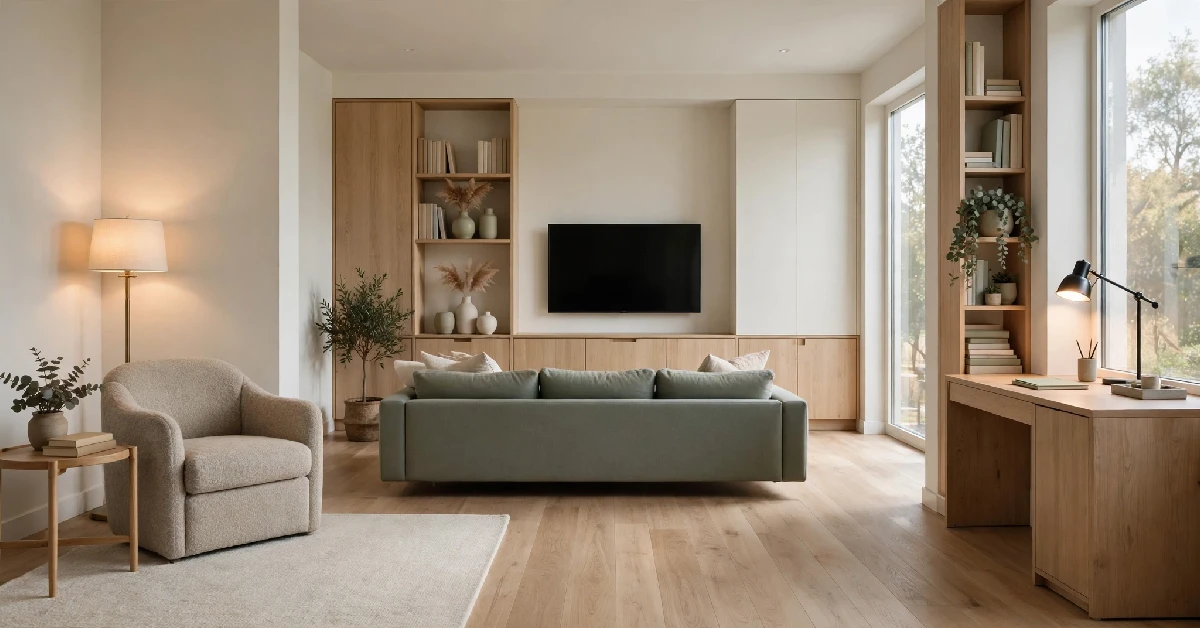
A homeware zone is a defined area of your home where furniture, storage, lighting, and accessories are chosen to support one activity. The term also describes a homeware section in a shop or an online store category. Good zones use rugs, light, and height to mark boundaries without walls. Name the activity first, then buy only what supports it.
Walk into most living rooms, and you will find three activities fighting for the same twelve square metres. Someone works at the dining table. Someone else watches television. A pile of school bags sits by the door because nobody decided where bags go. The room is not too small. It is simply undivided.
That is the problem a homeware zone solves. The idea is simple. You decide what an area is for, then you buy and place homeware that supports that one job. This guide explains what the term means, where it came from, and how to set up zones in a real home. You will get a step-by-step method, room-by-room ideas, lighting rules, storage picks, and the mistakes that quietly undo the whole effort.
What a Homeware Zone Really Means
The phrase carries two meanings, and search results mix them together.
The first meaning is retail. A homeware zone is the section of a department store or the category page of an online shop where cookware, bedding, lamps, storage, and decorative pieces sit together. Retailers group these products because shoppers rarely buy a single item. Someone buying a duvet usually needs pillowcases too.
The second meaning is design. Here, a homeware zone is a defined area inside your home, marked out by the things you place in it rather than by walls. A reading corner with a chair, a floor lamp, and a side table is a zone. A drop point by the front door with hooks, a tray, and a bench is a zone.
This guide covers the design meaning, with shopping advice attached, because that is what most readers need once they understand the term.
Why Homeware Zones Matter Right Now
Homes are doing more jobs than they used to. Remote work, home fitness, and multigenerational living all pushed extra activities into the same floor area, and open-plan layouts removed the walls that used to sort them.
Spending reflects that pressure. IMARC Group put the global homewares market at about 1,762 billion dollars in 2025 and projects steady annual growth near 3.85 per cent through 2034. Data Bridge Market Research reports that furniture alone took 28.4 percent of homeware revenue in 2024, driven by demand for space-saving and modular pieces.
Renovation data points the same way. The 2025 U.S. Houzz and Home study, based on responses from 10,981 renovating homeowners, found that 54 percent took on renovation projects in 2024, with another 54 percent running decorating projects. Median spend on a major remodel of a small kitchen under 200 square feet rose 9 percent to 35,000 dollars. People are putting real money into small areas, which makes planning those areas worth the effort.
Designers have noticed. Houzz home design expert Mitchell Parker highlighted zoned built-ins as a leading 2026 trend, describing cabinetry walls that combine areas for televisions, fireplaces, open and closed storage, benches, and bars into one feature. His point about the result is practical: using wall space this way reduces the need for extra furniture, so rooms feel more open.
How to Build a Homeware Zone
Work in order. Skipping the first two steps is why most zoning attempts fail.
- Watch the room for a week. Note where people actually sit, drop things, and plug in devices. Design for real habits, not ideal ones.
- Name each zone with one verb. Read, eat, work, drop, play. If you cannot name it in one word, the zone is doing too much.
- Set the anchor piece first. A sofa, a desk, a bench, or a table. Everything else follows this decision.
- Draw the floor boundary. A rug, a change in flooring, or a low shelf tells the eye where one zone stops.
- Add the light layer. Each zone needs its own switchable light source, which is what divides a room at night.
- Give the zone storage that matches its verb. A reading zone needs a place for books, not a drawer of chargers.
- Leave the walkways clear. Keep 30 to 36 inches for main routes and 24 to 30 inches for secondary paths between zones.
Follow that order, and you avoid the usual trap, which is buying accessories before deciding what the area is for.
Five Zones Worth Setting Up First
Start where friction is highest.
The entry drop zone handles keys, post, shoes, and bags. A bench, wall hooks at two heights, and one closed basket cover most households. This zone pays back fastest because it stops clutter at the door.
The cooking and prep zone works best when you separate the counter you cook on from the counter people gather at. Keep daily tools within arm’s reach of the hob and move seldom-used appliances to a cupboard.
The eating zone needs a table, seating, and a light fixture centred over it. Hang a pendant 30 to 36 inches above the table surface so it defines the area without blocking sightlines.
The rest and reading zone asks for a chair angled away from the television, a side table at armrest height, and a lamp behind your shoulder. Two square metres is enough.
The work zone belongs against a wall or a window, not in a walkway. A desk, a task lamp, and one closed storage unit keep it from spreading into the rest of the room.
If your bedroom is carrying several of these jobs at once, the room dimensions decide what is realistic. Our guide to 10×12 bedroom design ideas works through layouts for exactly that footprint.
Lighting Rules That Separate Each Zone
Lighting is the cheapest zoning tool you own, and the most commonly skipped.
Interior designers work with three layers. Ambient light covers the room, task light serves an activity, and accent light marks a feature. Lutron’s guidance on layered lighting stresses that once all three layers are in place, centralised control lets you shift the mood of a space without changing a single fixture.
Designers interviewed by Forbes in 2025 gave two rules worth copying. Designer Young recommends aiming for at least three light sources per room to avoid harsh shadows. Designer Heather Mastrangeli of Innovatus Design uses what she calls the lighting triangle, placing lamps in at least three corners of a main seating arrangement for even coverage.
Apply that to zoning with three habits:
- Give every zone at least one light you can switch independently.
- Put each layer on its own dimmer so zones can be bright or dark separately.
- Keep colour temperature consistent inside a room, roughly 2700K to 3000K in living and sleeping areas.
Wall colour changes how far that light travels. Soft off-whites bounce light into corners, which is why they suit homes with few windows, and our breakdown of Swiss Coffee paint colour explains how that shade behaves in different light.
Storage Choices That Keep Zones Working
A zone only holds its shape if the things used there live there. Storage is what makes that possible.
Closed storage handles items with no visual value: cables, cleaning supplies, spare batteries, paperwork. Open shelving suits items you want to see and reach daily, such as books, plates, or plants. Most zones need both, at roughly a two-to-one ratio in favour of closed storage.
Height matters more than footprint in small rooms. A tall narrow unit holds more than a wide low one and takes less floor space, which keeps walkways clear. Under-seat drawers, ottoman storage, and bed drawers add capacity without adding furniture.
Buy containers after you sort, never before. Measure the shelf, then buy boxes that fit it exactly. Mismatched boxes waste 20 to 30 per cent of available depth.
Labelling sounds fussy and is not. If the person who did not set up the system cannot find the batteries, the system ends within a month.
Bedroom zoning gets easier when the furniture is already coordinated, and a matched full-size bedroom set gives you the bed, dresser, and nightstand in one decision.
Shopping for Homeware Zone Products
Online is where most of this buying now happens. Dataintelo’s homewares analysis projects online stores taking about 35 percent of global homeware sales by 2034, up from roughly 26 percent in 2025. That shift gives you more choice and more room for error, since you cannot feel a fabric through a screen.
Three checks reduce the risk:
- Buy the anchor piece in person where you can. Sofas, mattresses, and dining chairs are hard to judge from photographs.
- Order fabric and paint samples before committing. Colour shifts noticeably under artificial light.
- Check return windows and who pays return postage on bulky items before you order.
The retail side of the term confuses people, so it is worth being clear. Several unrelated businesses trade under similar names. Homeware Zone in the Maldives is an electronics and household goods retailer with a large social following. Zone Denmark is a separate Danish design brand known for bathroom and kitchen accessories, sold through stockists across Europe and New Zealand. Searching the phrase will return all of them, so add your country or the product category to get useful results.
Price bands are wide, and quality tracks construction more than brand. For storage, look for solid backs and fixed shelving rather than thin panels. For lighting, check the lumen output and whether the fixture is dimmable before you buy.
Mistakes That Undo Your Zoning Work
Most failed zones share the same causes.
Buying accessories first is the common one. Cushions and vases cannot define a space. Structure does that, and structure means furniture placement, flooring, and light.
Undersized rugs are the second. A rug that floats in the middle of a seating group makes the zone look smaller, not larger. The front legs of every seat should sit on the rug.
Blocked sightlines come third. Tall furniture placed at right angles to the room cuts the space in half visually. Keep dividers below eye level, around 120 to 140 centimetres, unless you genuinely want the area closed off.
Too many zones is the quiet one. A room can support two zones comfortably and three at a stretch. Past that, the room reads as clutter regardless of how good each zone is.
Finally, ignoring sound. Open plan zoning fails on noise more often than on looks. Rugs, curtains, upholstered seating, and bookshelves all absorb sound, and adding two of them changes how separate a zone feels.
FAQs
What exactly counts as homeware?
Homeware covers household items used to furnish and run a home: cookware, tableware, bedding, curtains, rugs, lamps, storage, and decorative accessories. Some retailers include small appliances and furniture under the same heading. In British and Australian retail, you will also see the plural form, homewares, used for the same category.
How big does a homeware zone need to be?
Smaller than most people expect. A reading zone works in about two square metres. A desk zone needs roughly 1.2 by 1.5 metres, including the chair pull-out. What matters more is the clear walkway around it, which should stay at least 60 centimetres wide.
Can you create zones in a rented flat?
Yes, and without any fixed changes. Rugs, freestanding shelving, floor lamps, folding screens, and furniture placement do all the work. Plug-in lighting on smart plugs gives you independent switching without touching the wiring.
Do I need a rug to define a zone?
No, though it is the easiest method. Alternatives include a change in ceiling light, a run of furniture backs, a paint colour on one wall, or a low bookshelf used as a divider. Rugs simply do the job with the least effort.
Is Homeware Zone a real shop?
Several businesses use the name. The best-known is a homeware and electronics retailer based in the Maldives. Other similarly named stores operate in different countries, and Zone Denmark is a separate design brand entirely. Check the domain and the shipping destinations before ordering.