

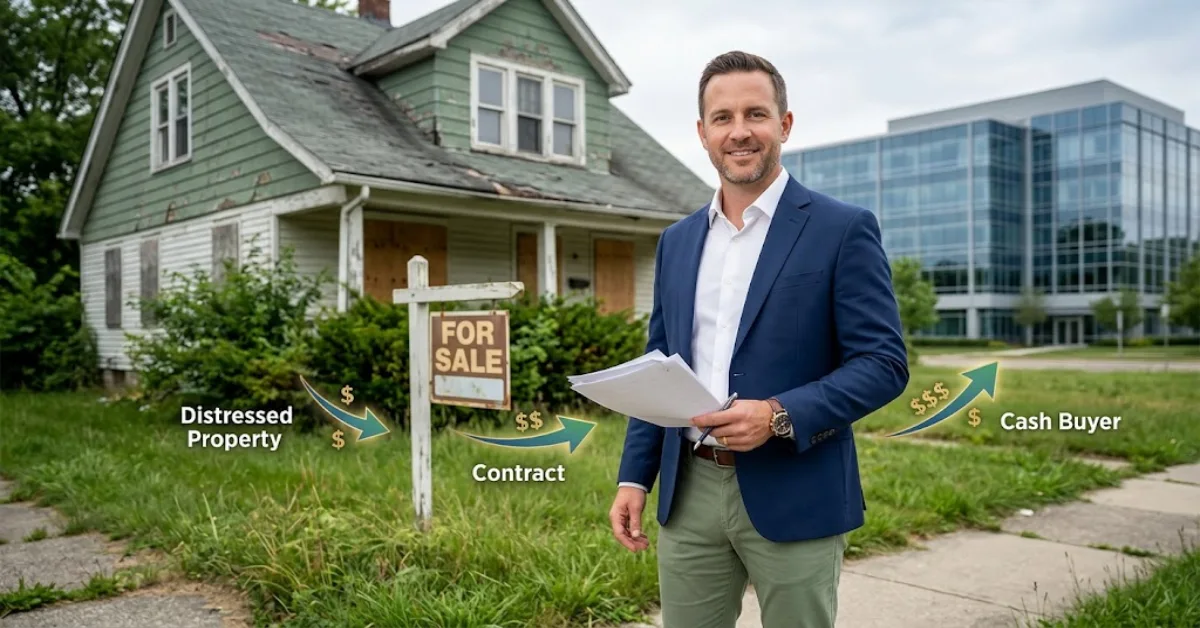
Real estate wholesaling is a strategy where an individual identifies properties, contracts them at a discount, and assigns the contract to an investor for a higher price. The wholesaler profits from the difference without ever owning the property. This approach requires minimal capital and can generate quick returns for those with strong negotiation skills and market knowledge.
Real estate wholesaling has become one of the most accessible entry points into property investment. Unlike traditional real estate purchases that require substantial capital and credit, wholesaling lets you profit by acting as the middleman between motivated sellers and cash buyers.
But what exactly is wholesaling? How do successful wholesalers identify deals, negotiate contracts, and find buyers? More importantly, what are the risks, and how do you navigate the legal landscape?
This guide breaks down the complete wholesaling process, from finding your first deal to closing your first assignment fee. You will learn how professionals build cash buyer networks, fund their operations, and avoid costly mistakes.
What Is Wholesaling Real Estate
Wholesaling is a short-term investment strategy where a wholesaler finds a property, enters into a contract with the owner, and then assigns that contract to another buyer for a profit. The wholesaler never takes ownership of the property. Instead, they connect sellers with investors and earn money from the price difference.
Here is a simple example: A homeowner needs to sell quickly. Their property is in poor condition and would cost $30,000 to repair. The wholesaler contracts to buy the home for $140,000. An investor who flips properties agrees to pay $160,000 for the contract. The wholesaler assigns the contract and keeps $20,000 as their fee.
This differs from being a real estate agent. Wholesalers bypass the traditional market and work directly with sellers and buyers. They do not list properties on the MLS or charge commission as agents do.
How the Wholesaling Process Works
The wholesaling process follows five clear steps:
Find a Property: Identify distressed or below-market properties. These are typically owned by motivated sellers facing financial pressure, foreclosure, divorce, or inheritance complications. Marketing to these sellers is the first step.
Negotiate the Purchase Agreement: Get the property under contract at a price significantly below market value. The contract should allow assignment without triggering the lender’s due-on-sale clause. This step requires solid negotiation skills.
Market to Cash Buyers: List the property among your network of investors, flippers, and landlords. These are buyers with cash ready to close and who actively seek deals. Building this network is essential to your success.
Assign the Contract: Once you find a buyer willing to pay more, assign the contract to them. The buyer becomes responsible for closing with the original seller. The assignment fee is your profit.
Close and Collect: The buyer and seller close the transaction directly. You are paid your assignment fee at closing. The entire process typically takes 30 to 90 days.
The 70 Percent Rule
Many wholesalers use the 70 Percent Rule to evaluate deals. This rule says you should aim to contract properties at no more than 70 percent of the after-repair value (ARV) minus repairs. For example, if a property will be worth $250,000 after repairs and needs $50,000 in work, the ARV is $250,000. Seventy percent of that is $175,000. After deducting repair costs ($50,000), you can contract at $125,000 or lower. This leaves room for investor profit and your assignment fee.
Finding Deals and Building Your Network
Success in wholesaling depends on two skills: finding deals and knowing buyers. Neither is automatic.
Finding Deals
Most wholesalers find deals through direct outreach to distressed homeowners. Methods include:
Direct mail to owners of distressed properties, tax delinquent homes, or properties in poor condition.
Driving for dollars. This means looking at neighbourhoods for vacant, boarded, or neglected properties, then researching ownership through county records.
Networking with real estate agents, attorneys, and property managers who refer deals.
Partnering with contractors and handymen who see distressed homes during their work.
Online platforms and auctions where distressed properties are listed.
Building a Cash Buyer Network
Without buyers, you have no deals. Successful wholesalers spend as much time building relationships as they do finding properties.
Start by identifying local cash buyers. These include house flippers, buy-and-hold landlords, home builders, and other wholesalers. You can find them through real estate investor groups, meetups, online communities, and networking events.
Create a property list or email newsletter that goes out weekly with your available deals. Make it easy for buyers to understand the property, see the numbers, and contact you. Many successful wholesalers maintain databases of 100 to 500 active cash buyers.
Understanding Risks and Legal Considerations
Wholesaling looks simple, but it carries real risks. Understanding them protects your business and your reputation.
Contract Enforcement
Not all contracts allow assignment. Some sellers will object to the wholesaling model or have contracts that prohibit transfer. If you assign a contract without permission, the seller can sue you and void the deal. Always ensure your purchase agreement explicitly allows contract assignment before signing.
Market Risk
If market prices drop after you contract a property, you may struggle to find a buyer at your assigned price. You will either have to lower your fee or walk away from the deal. In extreme market shifts, your assignment fee can disappear entirely.
Licensing Requirements
Some states require wholesalers to have a real estate license if they conduct multiple transactions or act as agents. Others do not. Research your state’s regulations before starting. Violating licensing laws can result in fines or criminal charges.
Buyer Liability
When you assign a contract, the buyer assumes all liability for the property. However, until assignment is complete, you may be liable for issues discovered during inspection or closing. A clear contract protects you by specifying inspection periods and conditions.
Funding Your Wholesaling Business
One advantage of wholesaling is that you need minimal upfront capital compared to traditional real estate investment. However, you will have costs.
Earnest Money Deposit
Most sellers expect a small deposit to show good faith. This is typically 1 to 3 percent of the contract price. For a $150,000 property, you might need $2,250 in earnest money. You will get this back at closing, but you need it upfront.
Operating Costs
Marketing, inspections, title searches, and legal fees add up. Budget $500 to $2,000 per deal for these costs. Your assignment fee should cover these expenses and generate profit.
Funding Options
Since wholesalers rarely own property, traditional mortgages are not an option. Instead, consider:
Personal savings or credit to fund earnest money and operating costs.
Partnerships where you contribute time and skill while partners provide capital.
Hard money lenders who will lend against the contract at 10 to 15 percent interest.
Private money investors who fund deals in exchange for a small share of profits.
Wholesaling vs. Other Real Estate Strategies
Wholesaling is one of several ways to make money with real estate. Understanding how it compares helps you decide if it matches your goals.
Wholesaling vs. Fix-and-Flip
Fix-and-flip investors buy, repair, and sell properties for profit. This requires significant capital, credit, and hands-on work. Profits can be 20 to 30 percent higher than wholesaling, but the timeline is longer (6 to 12 months). Wholesalers skip ownership and repairs, earning faster profits with less money and risk, though assignment fees are typically smaller ($5,000 to $25,000 per deal).
Wholesaling vs. Buy-and-Hold Rental
Buy-and-hold landlords purchase properties, rent them out, and build wealth over years through appreciation and rent collection. This requires capital for down payments and ongoing management. Wholesaling generates quick, one-time payments with no ongoing responsibility. Choose buy-and-hold if you want long-term wealth. Choose wholesaling if you need immediate cash flow.
Common Mistakes and How to Avoid Them
Experienced wholesalers often share the same lessons from early mistakes. Learning from them saves time and money.
Overestimating Assignment Fees
New wholesalers often contract properties at prices that leave insufficient margin for investors to profit. Investors will walk away if the deal does not pencil out for them. Use the 70 percent rule and get experienced opinions on ARV before contracting.
Neglecting Your Buyer List
Without buyers lined up before you contract a property, you have no one to assign to. Spend the first 60 days of your wholesaling business building relationships and finding cash buyers. Deals will come later.
Ignoring Due Diligence
Always verify property condition, title, zoning, and liens before assigning. An inspector’s report costs $300 to $500 and protects you from assigning a problematic property. Your reputation is your most valuable asset.
Weak Contracts
A poorly written contract can cost you thousands. The contract must allow assignment, include appropriate inspection periods, specify contingencies, and protect your interests. Have a real estate attorney review your standard contract template before you use it.
Getting Started With Real Estate Wholesaling
Real estate wholesaling is accessible to anyone willing to learn the process and do the work. You do not need perfect credit, a large bank account, or years of experience. What you do need is persistence, negotiation skills, and a genuine network of cash buyers.
Start by studying your local market. Understand recent sale prices, property conditions, and who the active cash buyers are. Spend your first 60 days building relationships and learning, not contracting properties. Then, use the 70 percent rule to evaluate deals carefully.
If you want to build a stronger foundation for property ownership success, explore strategies for minimising financial risks related to property ownership and understanding different investment approaches to complement your wholesaling efforts.
With clear contracts, a solid buyer list, and disciplined deal analysis, wholesaling can generate consistent income while you learn the real estate business. Start small, complete your first deal, and build from there.
FAQs
Can you wholesale real estate with no money down?
Technically, yes, if you can negotiate earnest money deposits with sellers or partner with investors who provide capital. Most wholesalers, however, need at least a few thousand dollars for deposits and operating costs. The real benefit of wholesaling is that you need far less capital than traditional real estate investing, not that you need zero dollars.
How much can you make as a wholesaler?
Assignment fees typically range from $5,000 to $25,000 per deal, though experienced wholesalers in hot markets can earn $50,000 or more per deal. Your income depends on deal quality, local market conditions, and transaction volume. Full-time wholesalers typically complete 1 to 4 deals per month.
Do you need a real estate license to wholesale?
This depends on your state and how you operate. Most states allow individuals to wholesale their own properties without a license. However, some states require a license if you buy and sell multiple properties annually. Check your state’s real estate commission guidelines before starting.
How long does a wholesale deal take?
From contract to assignment to closing typically takes 30 to 90 days, depending on inspection periods, buyer availability, and funding timelines. This is one advantage over fix-and-flip investing, which can take 6 to 12 months.
What happens if you can’t find a buyer for a property?
If you cannot find a buyer willing to pay your assigned price, you have limited options. You can lower your fee, try to renegotiate with the seller, or walk away and lose your earnest money. This is why building a strong buyer network before contracting properties is critical.